Monday, October 15, 2007

Mochima Park-Venezuela

We departed with Alex and Isabelle, a young French Canadian couple on Masterpeace, to cruise through Mochima park. Popular sentiment was to buddy boat while anchoring in the remote sections of Mochima park for deterrence against thieves that come in the night. Often we are asked about safety in Venezuela. No doubt, crime is a huge issue, with half of our close friends have an actual or attempted robbery. However, many of them visited areas specially discouraged in our cruising guide. Our experience was very positive with friendly people, and prices on goods and services we could find nowhere else.

Our first stay was deep in the multi-bayed cut in the hills that lead back to the actual town of Mochima. We later met up with Grace also in the stunning NE corner of Golfo de Sana Fe known as Bahia Petare. The reefs were full of fire coral and blanketed in every color of Christmas tree worms. We have never seen anything like it anywhere. The kids laughed and delighted as they waved their hands over them and watch them suck back in and disappear.

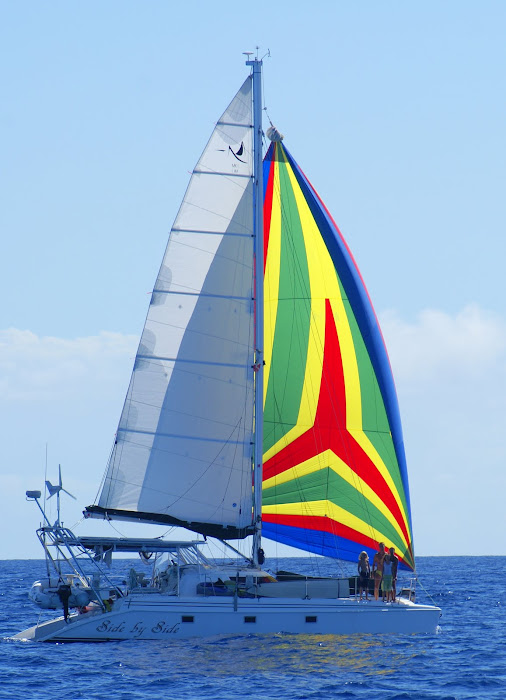
Sadly, our time with Chris and Chris on Grace was drawing to a close. They needed to get moving west and then onto Jamaica and Florida. We hope to visit England be the guests of the self-proclaimed Queen and Queen of England. Our next stop was across the bay from Puerto La Cruz in Chimana Grande. Our guidebook pictured a boat that looked like it was sitting in a land-locked pond. Now we have the same picture taken in Cienguita with Side-by-Side in the lagoon surrounded by reddish tinged hills on all sides. Parker, Sabrina, and I went free climbing one morning in hopes of being kings of the mountain. As we were nearing the top, the looseness of the stone and pitch of the hill were too much for my adventurous soul. Parker is credited with having scampered an additional 50’ further higher than Sabrina and I. Fortunately we avoided falling into any cactus or sustaining anything more than a few scrapes.

Wednesday, October 10, 2007

Iiissss . There Anybody Out There?" in Guacharo Caves

For the group trip to the guacharo caves, I was anticipating a junked 1970’s “Dodge church van” that was exhumed from the dead for service in Venezuela. Instead a brand new Mercedes Benz Sprinter van with A/ C and a professional sober driver showed up. Now we are talking.

Within just 10 miles, the vegetation turned from dense cactus growth to lush tropical. Along the road we noticed an above ground water pipeline that carried water from the mountain reservoir to Margarita Island. Pro Chavez stencils were painted on the pipe every kilometer or so. Every town, it seemed, had some public works project underway and a huge Chavez poster with his picture on.

We stopped by an old mission church from the 1700’s where the bells and a wall of the old church still remain. Smartly uniformed school children were standing around where we stopped. Apparently their teacher who has to come from 2 hours away was delayed and therefore, no classes. Teachers, we learned, are in short supply, not well paid, and stretched thin trying to fulfill Chavez’s educational initiative.

The roads up into the mountain were excellent, minus the guardrails considered a frivolous expense in most Latin countries. The air was cool and damp when we arrived at the Guacharo caves near Caripe. It is 8 miles long, one of the world’s largest and most magnificent caves. What makes it particularly interesting was that it was inhabited by some 18,000 guacharo birds. These large strange creatures: live in the dark, echo-locate like bats, and only come out at night to feed on fruit. They are sensitive to light so only the guides’ lanterns are allowed. The strident cry of what sounds like all 18,000 birds calling at once adds to the atmosphere. Jean Marc’s wife was thought to be our interpreter but backed out just as we were getting our tickets, saying she doesn’t do caves. So Angie with her high school Spanish and concentration did her best to translate.

The kids learned about all about the addictions of nicotine on this trip. Three chain smokers joined us on the trip, who could not wait to leave the non-smoking cave. The guide was asking for them to hold up, but they were nearly running to get to day light after 2 hours without nicotine! Every time the van stopped they already had their cigs in mouth and lighter lit before their foot hit the ground. After enjoying a stop for some strawberries and cream, we headed back high above a valley of clouds. It was like a fairy tale scene looking down into the cotton filled valleys with other peaks rising up out of the clouds like islands in the sky.

Friday, October 5, 2007

How fresh do you want your meat?

On the SW corner of the Golfo de Cariaco is the city of Cumana, the place to get your “free” fuel thanks to Chavez. We met up with our good friends with kids on “Sea You Manana”. The kids loved the ice cream and video arcade in the waterfront plaza. The next morning, it was off to the local marker. Unlike the touristy straw markets of the islands or the upscale farmers’ market back in Saratoga, this was a real local market where everyone comes to buy and sell food, clothing and supplies. Some vendors operate out of an old pick-up truck, others under a tarp or a tin roof. Most towns have a market with covered stalls housing the meats and fish vendors. The aroma reminded me of the days I use to spend helping grandpa at Ken and Bea’s Grocery. He used to take me to Smitty’s meat packing where I saw how the pigs in the corals ended up as pork chops at the other end. Here, we strolled by sides of cows and pigs hanging about as butchers would lop off sections as needed with their razor sharp knives. Chickens were pre-plucked and then “prepped” with the WHACK of a machete. If you prefer yours really fresh, you can carry them off flapping and squawking, swinging by their bound feet. Parker preferred to do his shopping at Hannaford and keep the butchering and related smell behind closed doors. We loaded up on everything (mostly vegetables and fruits) at prices that were a fraction of the US. The Bolívar rate was changing daily and was now at over 5000/$1 within a couple of weeks. While we were there the marina doubled their rate to cruising boats. We ended up paying $17/night including A/C before leaving, while our friends paid $8. Prior to leaving, we filled up our tanks and jerry jugs with diesel and 96 octane gasoline at $.04 a gallon, 100x cheaper than anywhere else! The “set” price by Chavez to keep the people happy is 47 Bolivars/gallon. At 4000-6000 bolivars to the $1, you do the math.

Thursday, October 4, 2007

Fisherman On!

We sailed off toward the mainland and the Golfo de Cariaco with Grace in light winds that moved the boats just fast enough to make Laguna Grande by dark. As we usually do, we trolled lines 100 yards behind the boat to see if dinner was out there. What was out there, were several fisherman buzzing at a high rate of speed between the mainland and Isla Margarita. Angie frantically yelling, la linea, la linea and making hand motions did not stop one boat. Our line caught the prop of a fishing boat. The zing of the reel as it spooled out confirmed why their boat was stopped. This was one ER situation we had not rehearsed. In case you need to know, here is the step by step plan when you catch a fisherman:

  1. Stop the boat (with no brakes, this one takes time).
  2. Yell to the fisherman as he tries to clear his prop.
  3. Watch the fisherman get pulled out of the boat and dragged as the fishing line gets caught around his hand.
  4. Get out the knife and cut the line to save the fisherman’s life.
  5. Hope the fisherman has better luck with your expensive lure than you did. Also hope he is not armed.

After that mini-adventure, we continued on our trip. Grace had better luck fishing and landed a nice tuna, much more edible than our catch.

Words cannot describe the landscape of this desolate place on the west end of the Golfo. The steep barren landscape is a collage of distinct earth tones ranging from white to rust to black. We hiked up onto the arid crushed rock hills created by seismic and glacier activity. The views were spectacular as were the unusual crystals and rock textures. We spelled our boat name in white rocks atop one of the hills. The water was a beautiful blue but very “cloudy”. Late that night as I was raising the swim ladder the water exploded in sparks of phosphorescent light given off by tiny jelly fish. Ahh, that’s why the water was so cloudy. I dove in looking like an asteroid shooting through space. Before bed we all laid out on the trampoline gazing up at the heavens above wishing upon falling stars.

Sunday, September 30, 2007

Don't get anchored in prosaic detail

We weighed anchor and motored east further into the 30 mile long Golfo bound for Medregal Village. The peninsula’s mountains are shaped like a continuous line of soft serve ice cream that changed from arid to green to tropical the further east we went. There’s this place, Medregal Villlage, run by a former Belgian Congo expat named Jean Marc that has become a cruiser’s destination. Over the years he began welcoming cruisers ashore to enjoy the pool and tropical rustic facility. The market trips, bar tab, and meals are all done on an honor system that is settled up when you leave. Foosball and ping pong were the games of choice for Parker. Sabrina enjoyed the company of Jean Marc’s daughter “Ya Ya”. We rejoined other boats we had last seen in Trinidad or Margarita.

For those sailors who really got stuck here, they ended up buying property next to Medregal village. I had to say I took an interest in what property was available for many reasons: no hurricanes, no tide, no barnacles, very safe due to its remoteness, beautiful views, trade wind breezes blowing from land free of salt air, easy access to great cruising grounds, and pricing 1/10 -1/100th of ocean property elsewhere.

We passed the days away enjoying conversation with others, playing games, lounging by the pool, and best of all, water color painting with Terri of Sea Otter. Terri reiterates what an art teacher once told her as she instructs us in water colors, “don’t get anchored by prosaic detail”, (i.e. stop wanting perfection). She is such a giving person and hopes to inspire others who like herself, didn’t know they had it in them. The Johnsons as artists.. who would have thought.

Sunday, September 23, 2007

Lowering our water line in Margarita

Monday morning, we boarded the “VIP” shopping bus to Sigo’s courtesy of Juan Marina and received our very important Sigo number pass. Later we learned the money we spend gives Juan and his family “points” at Sigo, so they essentially eat for free. See, you like that angle? And we thought the numbers were for free coffee.


Margarita, a duty free shopping zone, had the cheapest prices in the Caribbean, mainly due to the unofficial exchange rate of the bolívar to the dollar. When we saw the prices, we thought we were shopping in the 1950’s! Where else can you fill a jumbo shopping cart to the top with wine and spirits for a $100? The best part of shopping, from my perspective, were the Scotch reps. I swear they were all former Miss Venezuela contestants, clothed in black low cut spandex tops and form fitting pants. We must have enough Scotch to last us for the next 5 years now. Oh, the rest of the market was fantastic too, except there were no eggs or milk.

Chavez has price controls to keep basic items affordable for the 80% of the population that is impoverished. Watching kids tear apart my trash moments after depositing it was heart wrenching. Price controls includes fuel at $0.04 a gallon, beer at $2/case, cigarettes at $0.10/pack and other “necessities” such as sugar, eggs, milk, flour, and meats. One of the problems is the producers aren’t able to cover their expenses at times and will not supply the product. The milk gets powdered and stockpiled somewhere so there is no milk available. The eggs are sold illegally in the streets and open air markets for a premium price.

Margarita has 4 star malls, shopping, dining, and accommodations and is the vacation destination primarily for Venezuelans. Gated apartment high rises overlooking the ocean start at $20,000 including all the amenities. The “rabbit market” as it is called has great basic clothing, pirated CD’s and DVD’s, and generally decent produce. Cruising the high end mall, we realized just how much we did not need anymore. Xmas was around the corner and Margarita served us well for the kids.
Wednesday, September 19, 2007

Los Testigos

The Los Testigos is a delightful group of island with about 160 inhabitants who live by fishing. Other than a church, a school, and a beach bar (tin roof stick structure with Regional beer pennants and loud music) there is nothing else. To get supplies, they jump in their pirogues and zoom over to the mainland some 40 miles away.

There is a Costaguardia post that allowed us to stay for 3 days before moving on and officially checking into the country. Angie’s primal Spanish and some smiles were sufficient to check in. The arid islands were quite beautiful and the people were very friendly.

Our best experience was the sand dunes of Playa Gozman. From the SE shore we climbed up a path-wide sand dune from the water’s edge up to the top. Along the way, there were thousands of white butterflies floating about like snow in the tropics! As we climbed the soft sand trail, we sunk to our ankles. Approaching the top, the trail starts to widen out with nothing but sand and a few clumps of bushes. Cresting the top to view the oceanside was stupendous. On this side, the dune opens up and descends onto a half mile beach. The windswept landscape of powder dunes, desiccated tree trunks, and the random clumps of green were beyond words. I vote this the most beautiful untouched beach in the world! We spent the day frolicking in the waves, walking the shore and playing on the sand dune.